
By Sam Nelson, VP of CX and AI, Telarus
Over the past year, more SMB owners have started asking the same question: “How do we provide 24/7 support without hiring three more people?”
They’re losing customers to faster competitors. They’re missing after-hours inquiries. And they know expectations have shifted permanently.
Many technology advisors still treat customer experience (CX) as a mid-market or enterprise motion. But some of the most consistent, repeatable growth opportunities are emerging in the SMB segment—especially around AI-driven self-service.
SMBs today face the same pressure as large enterprises to deliver Amazon-level responsiveness. The difference? They rarely have the staff or infrastructure to do it.
According to Madrid-based CX startup Wolly, 67% of SMBs lose customers when they respond to customers too slowly . And 65% of important inquiries arrive outside of normal business hours when teams are unable to reply.
The good news is that SMBs can easily level up their CX using cost-effective self-service tools which enable faster resolutions and consistent support. In this post, we’ll examine what self-service entails, why the SMB market can be a powerful growth lever, and how to aggressively deploy technologies in 30 days or less.
What Is SMB AI Self-Service in Customer Experience?
SMB self-service customer experience refers to AI-driven tools—such as chatbots, automated voice systems, and knowledge bases—that allow customers to resolve issues without speaking to a live agent.
Customers can:
- Access account information
- Track orders
- Get product answers
- Navigate billing issues
- Reset passwords
- Schedule appointments
All without waiting on hold.
Gartner says that by 2029, AI will autonomously resolve 80% of common customer service issues without human intervention—resulting in a 30% reduction in operational costs.
For SMBs, this isn’t theoretical. It’s operational leverage.
Core Self-Service Tools SMBs Are Deploying Today
Here are the most practical self-deployment tools organizations are leading with:
- AI chatbot templates
Off-the-shelf, customizable conversation frameworks that automate common support interactions.
- Drag-and-drop knowledge base tools
Searchable libraries built from existing documentation, FAQs, and GenAI-assisted content.
- AI routing software
Intelligent call and chat routing based on behavior, context, and intent.
- CRM + helpdesk integrations
Personalized service using real-time customer data.
- AI transcription and interaction summaries
Automated interaction summaries of calls and chats to improve follow-up and accountability.
These tools do not require a six-month transformation roadmap. They require focused execution.
Do Customers Actually Prefer Self-Service?
Short answer: Yes—when it works.
According to Zendesk, 67% of consumers are eager to use personal AI assistants for service issues, nd more than half prefer bots over humans when they want immediate service.
That said, some individuals still prefer communicating with live agents.
The most effective SMB CX environments follow a simple rule: automate the routine, elevate the complex.
When tier-1 inquiries are deflected:
- Agents respond faster
- Escalations improve
- CSAT increases
- Staffing pressure decreases
Why Advisors Should Focus on SMB Self-Service
SMBs may not produce enterprise-sized contracts, but you can bet they’re often less complex and more willing to experiment with new technologies.
For advisors, stacking multiple CX deals with SMBs can be more profitable than chasing enterprise “whales,” especially when factoring in the long-term residual revenue these deployments can generate.
Self-service is often the easiest entry point into a customer environment because:
- Quick wins: Automated self-service and AI-powered interactive voice response (IVR) systems can reduce calls by around 40%, resulting in clear ROI while also reducing resolution times and lowering missed call rates.
- Fast deployments: Most self-service solutions deploy in under a month with minimal support, resulting in less pushback from overburdened IT teams.
- Cost savings: Deflecting tier-1 support calls lowers operational costs and reduces agent workloads, helping SMBs scale CX without increasing headcount.
For technology advisors, there’s your business case conversation.
Applying the CX Maturity Model for SMB Clients
In our recent State of the Union for AI and CX, we explained how not every organization is equally ready.
As the CX Maturity Model illustrates, some organizations may have little to no formal CX strategy in place, while companies at the other end of the spectrum have mature, well-defined programs.
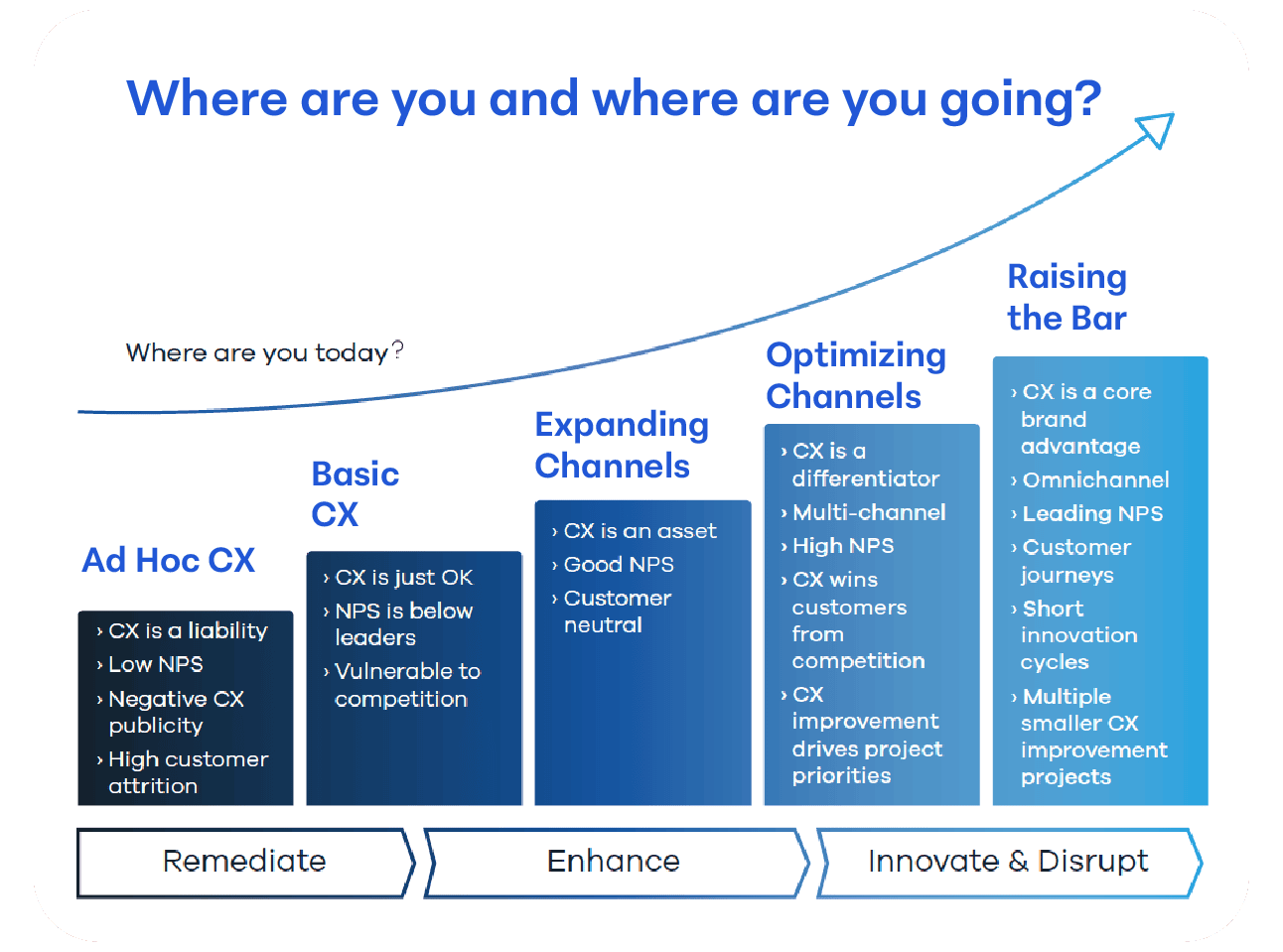
Technology advisors can use the Maturity Model to assess where customers are in their CX journeys and identify specific areas of improvement.
How to Deploy Self-Service in 30 Days
Large-scale CX transformations can take quarters; self-service initiatives usually move at a much faster pace, depending on an organization’s structure, culture, and operating environment.
Below is a practical 4-week rollout model advisors are using with their customers successfully:
- Week 1: Assessment and Planning
- Determine the customer’s overall CX maturity level and pain points.
- Identify the top customer questions, ticket types, and communication channels.
- Conduct readiness assessments by reviewing data sources and existing content to ensure self-service tools launch smoothly.
- Map desired outcomes such as faster response times, improved customer satisfaction scores, and lower operational costs.
- Week 2: Build the self-service foundation
- Design drag-and-drop knowledge bases.
- Configure and customize chatbot templates.
- Integrate CRM data with helpdesk systems to improve personalization.
- Create direct escalation paths to live agents.
- Week 3: Automate and optimize
- Activate AI routing to guide customers towards resources.
- Integrate transcription services to support customers and agents.
- Test all troubleshooting workflows.
- Pilot internally with staff or select customer segments.
- Collect and review feedback.
- Week 4: Launch and expand
- Deploy self-service tools across all customer-facing channels.
- Monitor CX KPIs to detect changes and monitor progress.
- Identify additional enhancements and integrations.
Remember: If there’s one thing you want to avoid when rolling out self-service tools, it’s “pilot paralysis.” Focus on making self-service operational and driving quick wins to demonstrate value and unlock ROI.
FAQ: SMB AI Self-Service
How long does it take an SMB to implement AI self-service?
Most SMBs can deploy foundational chatbot and knowledge base tools within 2–4 weeks if basic documentation and CRM systems exist.
Does self-service reduce customer satisfaction?
When implemented correctly, it increases satisfaction by reducing wait times and improving consistency. Human escalation should remain accessible.
What is the ROI of self-service automation for SMBs?
SMBs often see 30–40% call deflection and measurable reductions in tier-1 support workload within the first 60 days.
Is AI self-service expensive for small businesses?
Modern cloud-based CX platforms offer subscription pricing that allows SMBs to scale without large upfront capital investment.
The Takeaway: Self-Service is a Foundational Need for SMBs
Customer retention is the lifeblood of an SMB. When organizations miss inquiries or fail to respond quickly, customers will likely seek competitors for answers—resulting in revenue loss, negative reviews, and brand damage.
Self-service is an obvious solution, yet many business leaders aren’t sure how to move forward. Technology advisors have a critical role to play by helping customers select the right self-service tools that align with their needs.
In addition, self-service can be an effective entry point into customer environments given the fast deployment timelines and high success rates. Advisors can use CX to earn trust, and then “land and expand” into additional deployments, including:
- Security and governance
- Network and performance optimization
- Data and analytics
- Additional AI deployments
For deeper advisory insights from Sam Nelson and team, watch our latest HITT Training video: HITT – The Evolution of Tech Advising.