
Telarus’ latest Tech Trends Report revealed a startling gap: Customers are chomping at the bit to learn about AI, yet nearly one in three advisors still aren’t discussing it with clients.
Following the report, our team took a deeper dive and found that advisors overwhelmingly want to have AI conversations, and view AI as a critical growth vector. Most advisors simply aren’t sure how to get started.
If you’re stuck in reverse with AI, then you’re in the right place. In this post, we’ll explore how AI differs from traditional technology advisory and why it requires a more strategic approach. We’ll also break down Telarus’ proven method for leading effective AI conversations and moving customers toward deployments that deliver measurable ROI.
Why AI Requires a Different Advisory Approach
Deploying AI isn’t the same as sourcing AI-powered solutions. AI is an outcome-driven capability that must be mapped directly to specific business challenges such as preventing financial fraud, eliminating manufacturing waste, and predicting supply chain bottlenecks.
Sourcing AI products creates marginal gains, but a well-executed AI deployment reshapes workflows, roles, and outcomes across the organization. This fundamentally changes the advisory conversation. AI advisory requires a much deeper level of planning and guidance. Rather than leading with tools or platforms, advisors must start with business outcomes and work backward to determine how AI can create real value.
Understanding and mastering this approach will help move beyond surface-level conversations and make AI “click” with customers.
Telarus’ Blueprint for Leading Effective AI Conversations
AI advisory may seem intimidating at first, but with the right framework in place it becomes structured and manageable.
The good news is you don’t need to build a plan from scratch. Telarus has already carved a path, distilling years of consulting into a clear, repeatable process that any advisor can leverage regardless of their knowledge or experience.
During a recent HITT Training session, we covered how advisors can use Telarus’ groundbreaking AI advisory framework to lead successful AI conversations. Here is a quick recap of each step.
1. Set the Stage (Why AI Now)
To begin, you’ll want to give the customer a big picture overview of AI—highlighting its growing popularity and widespread adoption while also acknowledging its challenges and limitations.
As our latest eBook explains, 95% of organizations report no significant return from GenAI initiatives, due to misalignment with day-to-day operations, fragmented workflows, and poor integration across systems.
The goal here is to explain the need for careful strategy, purpose, and vision with AI. This will frame the rest of the conversation and help manage the customer’s expectations around what AI can and can’t do. At the same time, it reinforces you as the trusted expert for vetting suppliers and mapping technologies to specific outcomes.
2. Clarify AI Hype vs. Reality
After setting the stage, the next step is to explain why so many organizations fail to achieve meaningful ROI from their AI initiatives.
Organizations today are often told that AI can deliver instant productivity gains, automated decision-making, and competitive advantage. In reality, AI adoption introduces complex implementation challenges, data quality issues, and significant skills gaps. Many companies underestimate these challenges, which is why AI initiatives tend to fall short of expectations.
Keep in mind that you don’t want to alarm the customer. The objective is to explain how a strategic approach can help avoid common pitfalls and position AI initiatives for long-term success.
3. Conduct an AI Readiness Assessment
By now, the customer should clearly understand that successful AI deployments require much more than just technology. This is where you pivot to introduce the advisory process, starting with a quick overview of AI readiness assessments.
Telarus recommends assessing organizations across five pillars:
- Data & infrastructure: Ensuring your data and infrastructure can support predictive and automated capabilities
- People & skills: Making sure teams have the expertise to adopt and maintain AI workflows
- Processes & governance: Establishing secure guardrails to protect data and identities
- Business impact: Creating a method to measure the value that AI produces
- Strategic alignment: Having a clear AI vision tied to business goals
The key message to convey is that planning head dramatically improves outcomes. A structured readiness assessment will uncover operational bottlenecks, data gaps, and risks before AI is deployed. This is similar to what companies do at the network level, by assessing traffic flows and capacity constraints before introducing new workloads or applications.
4. Identify Business Priorities
The next step is to pivot the conversation back to the customer and ask about their core business objectives.
The goal here is to identify key business priorities and the pain points that are preventing the organization from achieving them and determine where AI can drive meaningful impact.
For example:
| Business Priorities | Pain Points | AI Solutions |
| Customer experience (CX) | Manual processes | Process automation |
| Revenue growth | Data silos | Predictive analytics |
| Cost optimization | Slow decision-making | Predictive insights |
| Compliance | Quality inconsistency | Quality control |
| Innovation | Resource constraints | Resource optimization |
Expert Insight: Ask the following: If AI could solve one problem for your customers or employees, what would have the most immediate impact? This will get your client thinking, differentiate you as an expert, and spark valuable dialogue.
5. Prioritize Use Cases
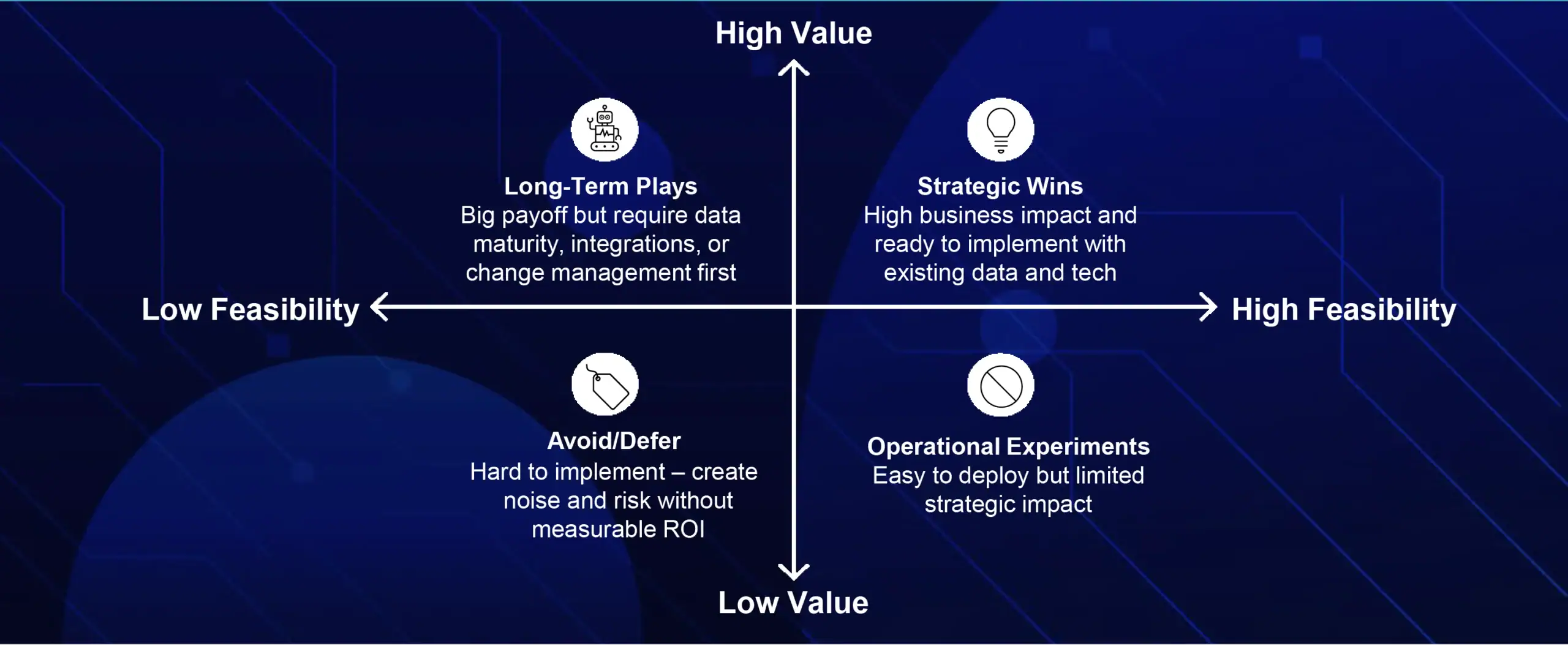
Business leaders often assume AI is a blanket fix that can be quickly applied to any business challenge. However, success doesn’t come from broadly applying AI. It requires starting with clearly defined problems. Remember that AI is like a GPS—it can take you anywhere, but first you need to enter a specific destination.
At this stage, you and the customer should identify one or two high-value use cases for initial pilots that can deliver measurable ROI and drive quick wins. The following chart can help balance potential impact with implementation feasibility.
6. Build an AI Roadmap
AI isn’t something that you can set and forget. Without a structured and phased approach, most AI initiatives will struggle to move beyond pilot projects—wasting time and money.
That’s why it’s necessary to roadmap each AI deployment, defining how AI will be operationalized and scaled across the organization.
Having a phased approach will reduce risk, accelerate value, and lay the foundation for strong user adoption and long-term growth.
7. Explain Your Engagement Model
Keep in mind that AI advisory is new for customers, too. Because of this, it’s a good idea to say a few words about your engagement model and explain how you intend to help the customer achieve maximum value from their AI investments.
During this process, it’s a good idea to outline how you will:
- Understand their unique business needs and success criteria through stakeholder workshops and assessments
- Source, vet, and recommend trusted suppliers
- Implement strategically and collaboratively to ensure achievements their outcomes
8. Present Next Steps
By the end of the presentation, the customer should have a clear understanding of the advisory process. The final step is to convert their interest into action and agree on next steps.
Some immediate actions include:
- Hosting a stakeholder workshop to align leadership on AI vision, priorities, and success metrics
- Scheduling a use case deep dive with a few high-priority use cases
- Connecting with pre-vetted technology partners who match your specific needs, budget and timeline requirements
Pro Tip: Before you suggest next steps, take a moment to do a quick temperature check. If the customer has expressed clear uncertainty about AI or is inching toward the door, don’t force the issue. Play the long ga
Tips for Approaching Customers About AI
We can’t stress this enough: Given today’s hype-driven market, AI conversations can quickly drift off course without a structured approach. The steps outlined in this article are specifically designed to control the scope of the conversation and maintain constructive dialogue.
Here are some additional points to keep in mind:
- Only discuss what you can monetize: AI is a massive discipline, so it’s important to keep your eyes on the prize. Sticking to Telarus’ AI pitch framework will help keep the focus on technologies that you can actually sell—and help avoid pitfalls that can leave the customer confused or second-guessing AI.
- Don’t focus on closing. It may seem counterintuitive, but early AI conversations shouldn’t be about closing. Your primary job is to educate the customer and guide them to solutions that solve challenges. Trying to close too early will almost certainly lead to a dead end.
- Listen more than you talk: The goal is to ask thoughtful, probing questions that encourage customers to open up about their challenges and needs. Using a note-taking tool and sharpening your listening skills can help ensure important insights don’t go overlooked.
Ready to elevate your AI advisory? Check out the HITT Training video for a fully replay: HITT- AI Advisory Pitch Deck Training for Tech Advisors.