
Advisor Success Stories Powered by Telarus Sales Engineering
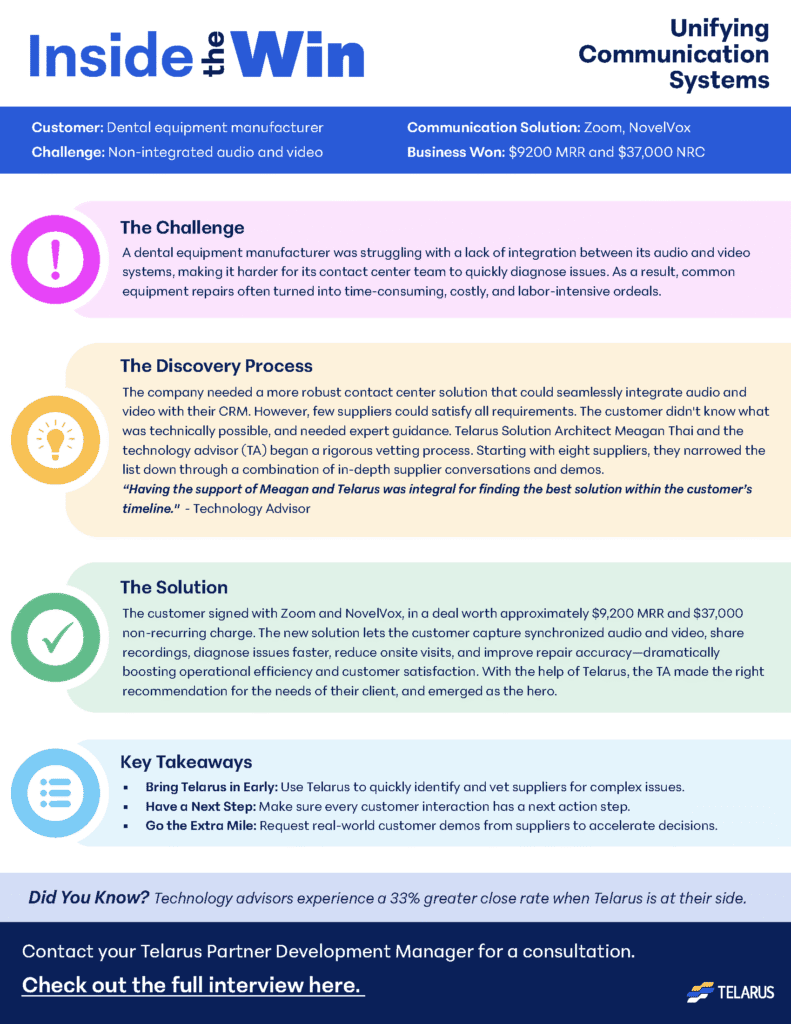
Download this Success Story to learn how:
- Efficient supplier vetting can streamline the supplier vetting process.
- A combination of tailored solutions can address customer challenges.
- Leveraging real-world demos can drive informed decisions.
Want the Whole Story? Listen to the Podcast!
Want More Wins? Check out the Inside the Win library
Video Transcript
Transcript is auto-generated.
Welcome to Inside the Win. We’ll break down real world wins, showing you exactly how strategic partnership with our experts empowers you to tackle your most ambitious opportunities with confidence. Let’s jump in.
What’s up, everyone? I am Sam Nelson, VP of CX, and welcome to Inside the Win: CX edition. We are here to give you insights on how early collaboration with our team can completely revolutionize your customer engagements. Joining me today is the one and only Meagan Thai, our CX and AI solution architect of the West. Meagan, how is it going?
Hi, Sam. It’s going great. It’s going great. Thank you.
Yeah. Great to have you. So today, we just wanna really focus on a specific win, share some details with our partners. So first things first, everybody wants to know about the money, right? Give us some financial insight into a particular opportunity we’re gonna discuss today. Like how much was it? What did we end up, you know, closing it on today?
Sure. Yeah. I like this one because it’s not like those big whales that we get once in a while, but it’s a it’s a pretty good amount. This one came out to be about ninety two hundred MRR just for the service. So ninety two hundred a month.
But on top of that, we also have some professional services, which was something like thirty seven thousand. So we split it up by twelve, which gives you another thirty one hundred in MRR. So we’re looking at, you know, ten to twelve grand, something like that, in MRR alone for this opportunity.
So Nice.
Yeah. That’s certainly not small. And a lot of these CX opportunities, I feel like, end up being a lot bigger than we think because we had started to have the conversation with the customer, we started uncovering more things. So let’s let’s dive into that. Talk to me about the type of customer, industry, and size.
Yeah. Okay. So this one was a little bit different.
They were a dental equipment manufacturer. So you got some sort of health care in there, but more than anything, they’re a manufacturing company. So think of, you know, the the dent when you go to a dentist, the dentist chairs, all the equipments, the compressors, anything except for the X rays is what they were manufacturing. And they were a b to b, so they only sold through their distributors. So dental equipment manufacturing company, they had two hundred and seventy five UCaaS users.
And And then a smaller portion of about forty contact center agents that we had to help find a new solution for.
Interesting. And so in that scenario, what kinds of pain points or I should say challenges were they experiencing? Because you think something like that is kind of a niche situation. Right? So what exactly were they kind of troubled with?
Sure. Alright. So their line of work, their business model was that they would have to dispatch They’re field techs. Okay? So if a chair wasn’t working correctly, they had to go on-site to take a look at it. Their biggest challenge was they had to do some video.
So on their current solution, they were doing an audio recording of it, and then they have the video of of what’s going on. Like, oh, this chair turned like this, and it started squeaking right there. Stop. Right there.
It squeaked. So the problem was it was two separate streams. So they would audio record on one solution, do their video on another solution, and they couldn’t couldn’t get the two to align. So it it caused a lot of challenges for them to try to figure out, hold on.
Stop. Let’s line this apart. Let’s let’s listen to it, and and let’s watch at the same time and figure out exactly where that squeaking happened so that we can figure out what needs to be replaced and what needs to be fixed. So was one of their biggest challenges, honestly.
And they do this all day long. And so their call center or contact center were the folks who were troubleshooting alongside with the the field techs. And, it it just caused a lot of problems. So we’re trying to help them solve for that specifically.
And they had other integration needs and whatnot, but that was the main issue that they were they were having. And they were using Zoho. So the other challenge was they wanted a solution that had UCaaS, CCaaS, video capabilities, being able to record the audio and video stream combined and integrated into Zoho. The fewer applications, the better.
You know, we hear this all the time. Right? Customers like, who wants seven, eight, fifteen different applications to work in? So they wanted us to streamline as much as possible.
That was another challenge.
Interesting. I’ve never heard of kind of a squeaky chair troubleshooting use case. That’s a first.
I know. For healthcare.
Yeah. Okay. So let’s talk about the actual, customer engagement, in terms of strategy formulation. Walk me through sort of what the timeline looked like from discovery to formulation to actual execution.
Yeah. This one, I like. This one moved, I feel like, a little bit faster than normal, but you know, so it didn’t go for years like some of our our typical, opportunities would.
This one is interesting. I was going back on the timeline of it.
And and then this partner of ours, RTA was so good. They’re usually really good at giving me a heads up. So it was, like, the week before Christmas, they shot me an email, and they said, look.
Ryan, like, they’re still working. We need your help on a discovery call. It’s not gonna happen till next year, but here’s the idea. And this was literally, like, the twenty something, right, right before Christmas.
And I said, that’s great. Thanks for the heads up. Come closer to the time. Let’s let’s sync up.
Let’s talk about it. So we did. And then I think by Feb, by early February, we finally had our first discovery call with this customer.
And it’s an hour long call, which is what we typically like to do for a first time discovery. So that was in early Feb.
That was one call. At the end of the call, what we told the customer and what I love about this TA is they always they always have a next step. So at the end of the call, they’ll say, great. Thanks for your time. Thanks for all this information. We are going to put our notes together, our heads together, come up with some vendor ideas, and we’ll remeet again at a later time. And we always establish the next meeting to to be had.
We met again in March. Yep. So it was, a good month, month and a half. So we met again in March with all the vendor recommendations.
And, again, this is what I loved about this TA. They do such an amazing job at putting everything together, gathering all the requirements, putting it into a nice spreadsheet.
At that time, right after the first discovery call, the TA and myself would brainstorm and say, okay. Let’s share notes. Who do you think? Who do you like?
Who do you you know, what what did the customer say that they didn’t like or they’ve evaluated before? Right? You get all that out out of the box. And then what you do is come up with a list of vendors, and our TA went to these vendors, sent them the requirements, and said, look.
We’re vetting them out. Are you guys a good fit? Check off the boxes. And so by the time we met again in March, we had this whole list.
Here are the vendor recommendations and why. Right? So we gave ourselves a about a month to do all the vetting out.
And so this TA What I love that they did, they went above and beyond. They actually spoke to each of these vendors because the tricky thing was that video portion. How do you if we have a contact center solution, how do you trigger the video portion to kick in?
And so what we realized is we really had to go after those UCaaS, the the robust UCaaS vendors with contact center as well because video is their strength. Right? And so we realized after vetting I don’t know. I think we went to six or eight different different vendors.
After vetting through a few, we found that the UCaaS vendors, the robust UCaaS vendors with some really good contact center capabilities were the ones that fit the mold better. So this TA actually went as far as talking to the vendors and saying, can you record a demo of when this video gets triggered. How does this happen so we can share it with our customers? It was amazing.
So we so that kinda helped us narrow down quite a bit. So, anyhow, when we met again in March, we went through, hey. Here’s the work that we’ve done. Here’s what we put together.
Here’s the whole requirements list. Here’s all the vendors checking off the boxes, and here’s some videos that we we’ve gotten from them, a recording of of the use case.
I’m telling you what the customers want when vendors oh, I’m sorry. When partners can do this for them, they are so appreciative of all the work that they put into it. They they know that you listened, and you understand the requirements. Right?
You’re you’re guiding down guiding them down the right path. So that was in March. And so then we help them narrow down, okay, all this list. Here are the check boxes.
Here are the videos. What do you think? Further narrowed down the list again and met back in June.
So now you got March to June time frame. In that in those several months, we help coordinate all the demo meetings, multiple demo meetings, meetings with the vendors. So by the time we got together again in June to do a feedback call right? So we started Feb was the first discovery. In June, we’re doing feedback now.
And from there, they they further narrowed down to where we were starting to help with contract negotiations. So that was June time frame.
And in August it’s August. I think it was August. Yep. They finally signed. So right before Christmas was the first time I’ve heard of it. In February was the first time we had a discovery call, and then they signed in August. So to me, that was fast moving.
But there is so much work in between, like, the that our TA took upon themselves to do to to help guide the customer down that path to make it an easier process for them. So I love it. So this TA, I can’t I can’t have enough good things to say about them. I mean, they do so much work that it makes my job easy as well.
Yeah. That’s incredible. I mean, that level of detail, it can is really, really time consuming, especially because a lot of these CX deals can become really complex. What options are available to TAs if they don’t have the expertise of like gathering all the requirements, putting them into documents and organizing demos and things like, it can be really overwhelming, right? Yeah.
Like what additional resources does your team have for TAs who don’t have that kind of capacity.
So I will find myself doing oftentimes, especially if it’s a larger or even even if it’s a smaller deal, but it’s complex in nature. Because I’m on this first discovery call. I take lots of notes. Our TAs now are also using things like AI Companion or Otter or whatever to transcribe and and summarize their meetings. So they use that, and we all share notes together.
Sometimes, and I’ve done this recently, Sam, and I told my partner to do this as well as take the notes, combine it, put it through chat GPT, see what it comes back with, tell it to summarize it for you. Right? And then help help have it help you build out a requirements list. I’ve had I’ve done that. And there’s some tweaking that has to be done, but you at least get some sort of a framework done. Okay? So that’s one one option.
The other option, of course, like I was saying, if it’s a more complex opportunity where I can lend a hand, I will actually take all the notes, summarize it myself as well, and put it into a PowerPoint. Slide one, here’s the current environment that you told us you’re in.
Slide two, here’s what we’re trying to help solve for. Here’s all the requirements. Here’s the the business drivers that is gonna help you make a decision.
And now here are the vendor recommendations. Okay? So I can help with some of that. I would say then come time for scheduling demos, I really would like the partner to handle that. If they need help, our operational folks, our PEAs can help as well. But, really, our partner should help with that process because they have access to the customer’s calendar, and they can work with a vendor to schedule all that. But I would say I mean, lean on me as needed through that process, especially with the discovery and the requirements because that can get a little bit complex and convoluted.
And then the more administrative, some of our PEAs can help or, of course, the partner can do most of it themselves.
Awesome. Well, I love that. It sounds like a ton of different best practices for our TAs as far as requirements gathering, setting, I would say, proper expectations. But even more importantly, bringing you in really, really early.
Right? Because, again, you mentioned they reached out right before Christmas, but you didn’t have the customer conversation until February. Yet that gave you and the TA a lot of time to really prepare and get as much data and just be as prepared as humanly possible for that initial discovery call, which, of course, ended up in a great win, which is fantastic. So thank you again, Meagan, for, like, sharing all these details.
Really, really impressive. Very clearly, folks, engage us early and often. Right? So with that said, joined here by the great Meagan Tighe.
Once again, thank you so much for joining me, Meagan. But folks, go ahead and stay tuned for our next Inside the Win episode to learn more about how leveraging our team leads to bigger and better results.