
By: Chad Muckenfuss, VP of Cloud
Microsoft is steadily adding and enhancing AI capabilities across its product portfolio, from Microsoft 365 to Azure. But beneath the surface, a much bigger shift is taking place.
With the shift from GenAI experimentation to Agentic AI implementation, Microsoft is fundamentally reshaping how businesses access and deploy AI, creating an extraordinary opportunity for technology advisors and their customers.
Let’s cut through the noise and focus on three insights that will help position yourself as the trusted AI adoption strategy advisor your clients need to compete, —and one critical tip that will transform the way you engage with customers.
Three Microsoft AI System Opportunities: From Infrastructure to Business Transformation
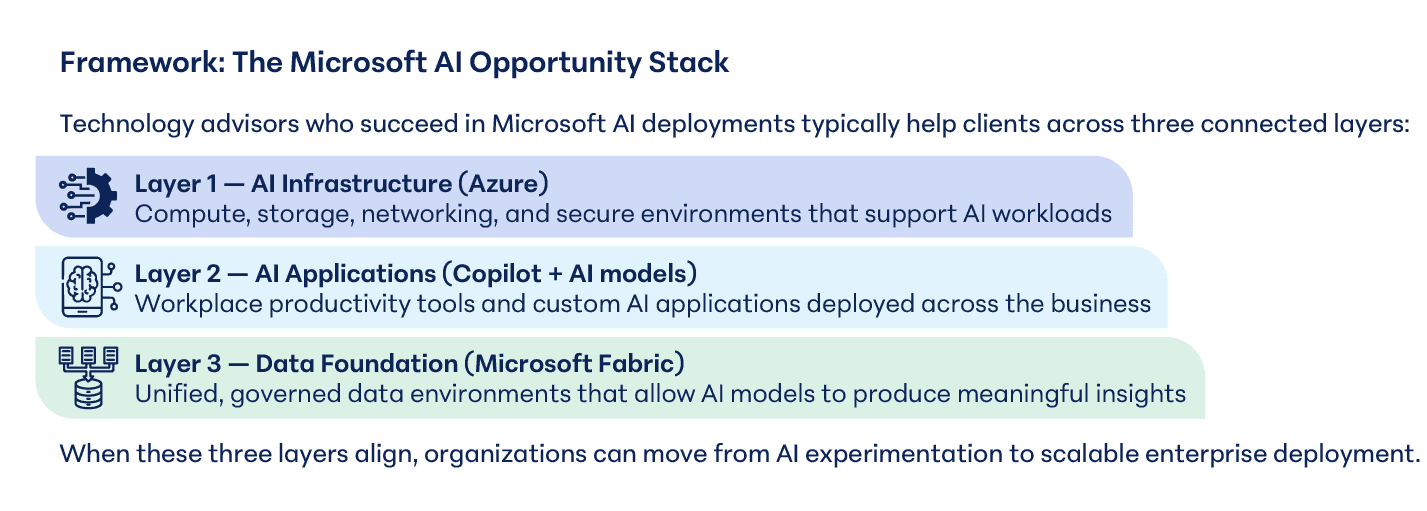
Microsoft provides three major AI system opportunities for technology advisors helping clients adopt enterprise AI:
- Azure AI infrastructure that enables secure, scalable AI deployment.
- Microsoft Copilot adoption strategies that deliver measurable productivity gains.
- Data modernization using Microsoft Fabric and Azure AI Foundry.
Advisors who guide clients across infrastructure, governance, and data strategy will capture the largest AI opportunities over the next several years.
Azure Infrastructure and AI Adoption Strategies for Enterprises:
Here’s what most advisors miss: Microsoft isn’t just integrating AI into its products. They’re building the entire highway system that makes enterprise AI deployment possible without requiring a team of expensive, PhD data scientists.
Up until recently, the mid-market has been largely locked out of meaningful AI deployments. Sure, organizations could use consumer AI tools or try to build custom solutions, but neither option delivers enterprise-grade security, compliance, or scalability most businesses require.
Azure AI Foundry provides a unified environment where organizations can deploy OpenAI models, open-source alternatives like Llama, or custom models without vendor lock-in. The client maintains control of their data, stays within their security boundaries with features like sovereign AI, and can switch models as the technology evolves.
Architecting Solutions and AI Adoption Strategies
Now you can architect real solutions and AI adoption strategies for clients who previously couldn’t play in this space. For example:
- Regional healthcare systems that need HIPAA-compliant AI for clinical documentation.
- Manufacturers that need AI-powered quality control within their secure LAN.
- Financial services firms that need to analyze sensitive data without ever sending it to a public model.
The commission opportunity here isn’t in the AI consumption itself—it’s in the infrastructure footprint required to support it. These deployments need compute, storage, networking, and often colocation or hybrid cloud strategies. A client who’s serious about AI isn’t buying a software license; they’re making a multi-year infrastructure commitment.
The conversation that opens this door is simple:
“How are you thinking about deploying AI within your security and compliance requirements?”
That question immediately separates the clients who are just experimenting with ChatGPT from those ready to make strategic investments.
Copilot Everywhere: Overcoming Barriers to Successful AI Adoption Strategies
Microsoft’s integration of Copilot across Windows, Microsoft 365, Dynamics 365, and its entire productivity stack represents the largest workplace transformation opportunity since cloud migration. But here’s the critical insight most advisors are missing: Successful Copilot deployments are business transformation initiatives. The organizations seeing measurable productivity gains from Copilot aren’t just buying licenses and hoping for the best. They’re overcoming barriers to successful AI adoption strategies by implementing strategic change management, establishing data governance frameworks, measuring ROI systematically, and treating adoption as a cultural shift rather than a software rollout.
Expanding Beyond Product Sales into AI Powered Productivity
This creates a perfect opening for technology advisors who are willing to expand beyond product sales into strategic consulting.
Your clients are already asking about Copilot. The question is whether you’re positioning yourself as someone who just quotes licenses or someone who helps them actually achieve the promised productivity gains.
Why Leveraging AI the Right Way Matters:
- Organizations that deploy Copilot without clean data governance will get mediocre results at best.
- Organizations that deploy Copilot without training their teams on new workflows will see limited adoption.
- Companies that can’t measure the impact will struggle to justify expansion when renewal comes around.
Advisors who help their clients build phased rollout strategies, implement proper governance, train users, and establish success metrics will become indispensable.
Remember, you’re not selling software—you’re delivering business outcomes with a competitive advantage. And you’re setting yourself up for additional expansion opportunities as AI capabilities evolve.
The commission math on Microsoft licensing can seem modest compared to infrastructure deals. But consider the lifetime value of becoming that client’s go-to advisor for their entire digital transformation strategy. Every AI initiative they launch, every infrastructure decision they make, every security question they face—you’re the first call.
The Fabric-AI Integration: Unlocking Your Clients’ Data for AI Initiatives
This is where the conversation gets interesting, because most AI initiatives fail on data fragmentation, not model limitations.
Microsoft Fabric’s integration with Azure AI solves a problem most clients don’t even realize they have yet: applying AI to actual business data without spending months on data engineering projects.
Fabric creates a unified data estate, combining data warehousing, data engineering, data science, real-time analytics, and business intelligence in one platform.
When you connect that to Azure AI, something powerful happens. Clients can suddenly apply AI models directly to clean, governed, real-time data without complex data movement or integration projects.
Putting Data-Driven AI in Motion
Most organizations have spent years accumulating data across disconnected systems—in legacy databases, modern cloud warehouses, SaaS applications, on-premises systems, and across departments. Every AI vendor promises to deliver insights, but the dirty secret is that AI is only as good as the data you feed it.
The clients who understand this are already asking the right questions: How do we unify our data estate? How do we establish governance without creating bottlenecks? How do we connect AI to our actual business data rather than just demo datasets?
The clients who don’t understand this yet are about to learn the hard way when their first AI projects deliver impressive demos but zero business value. Your opportunity is to help customers avoid that expensive lesson. The conversation starts with understanding their current data architecture, identifying fragmentation points, and building a roadmap that connects adata-driven strategy to their AI ambitions. Keep in mind, this isn’t about selling a specific product. It’s about diagnosing where they are, mapping where they need to go, and architecting the infrastructure and data foundation that makes AI investments actually deliver ROI.
The AI-Driven Conversation that Changes Everything
The biggest mistake technology advisors make with AI-driven opportunities is leading with features and demos.
Don’t pitch Copilot. Don’t sell Azure AI Foundry. Don’t push Fabric.
Instead, ask open-ended questions like these:
- “How are you thinking about AI’s impact on your business over the next 18 months?”
- “Which five manual processes, if automated by an AI agent today, would give your team 20% of their time back?”
That question creates space for real conversation. Maybe they’re excited but don’t know where to start. Maybe they’ve tried some experiments that didn’t deliver value. Maybe they’re worried about competitors moving faster. Maybe they don’t know how to effectively empower employees. Or maybe they’re drowning in vendor pitches and need someone to cut through the noise.
With this approach, you’re not selling—you’re diagnosing. And when you help that CIO or CFO make sense of AI strategy, build a realistic roadmap, and avoid expensive mistakes, you become their trusted advisor for everything that follows.
FAQ: Microsoft AI Infrastructure Advisory
How does Microsoft help mid-market organizations adopt AI?
Microsoft’s Azure AI and Azure AI Foundry enable companies to deploy LLMs and AI applications within their existing security and compliance frameworks. These platforms enable organizations to build, test, and deploy AI solutions using scalable cloud infrastructure.
How can organizations achieve stronger ROI from Microsoft Copilot?
Organizations typically achieve stronger ROI from Microsoft Copilot when they approach deployments as business transformation initiatives, as opposed to software rollouts. This requires strong data governance, employee training, and workflow integration.
How does Microsoft Fabric work with Azure AI?
Microsoft Fabric and Azure AI enable organizations to apply AI to their existing business data. Fabric combines data engineering, warehousing, analytics, and business intelligence into a single environment, making it easier to prepare and govern data for AI applications.
How do I monetize Microsoft AI as a Technology Advisor?
Technology advisors can monetize Microsoft AI opportunities by helping clients deploy and manage the infrastructure required to support AI workloads. This includes Azure cloud services, data platform modernization, networking, storage, and security solutions. Advisors can also generate revenue through consulting services, AI readiness assessments, and ongoing optimization.
Your 2026 AI Technology Strategy: Become the Infrastructure Advisor Clients Need
Microsoft’s AI partnership ecosystem represents a fundamental shift in how businesses operate, how employees work, and how companies compete. The advisors who thrive in this environment won’t be the ones who know the most about AI technology. They’ll be the ones who help clients navigate the messy reality of deploying AI within existing infrastructure constraints, organizational politics, budget limitations, and compliance requirements.
The tools exist. Client demand and adoption rates are real. And the business problems are pressing and immediate. The only question is whether you’re positioning yourself as a product vendor or the strategic infrastructure advisor your clients need to navigate the most significant technology transformation since the advent of the internet.
The advisors who move strategically today will build relationships and recurring revenue streams that compound for years to come.
Talk with a Telarus Cloud Strategist About Your Next Microsoft AI Opportunity.
If you’re helping clients explore Microsoft AI solutions, Telarus cloud experts can help you design the infrastructure strategy behind it.
From Azure architecture to data platform modernization and AI readiness, our engineering team works alongside advisors to build solutions that actually deliver results.