
As a technology advisor, you’ve likely asked yourself: “Should I focus on mid-market companies or large enterprises?”
Both markets offer strong revenue potential for advisors, but require different engagement strategies. The 2025-26 Telarus Tech Trends Report reveals a growing divide between the two segments, with mid-market buyers moving with much greater speed and agility while enterprises face longer buying cycles and added complexity.
This article explores how mid-market vs. enterprise organizations compare, why the mid-market is the sweet spot for technology advisors , and strategies for engaging enterprise buyers and moving conversations forward.
What’s the Difference Between Mid-Market and Enterprise?
Before we dive in, here’s a quick refresher on how mid-market organizations differ from enterprises:
What Is a Mid-Market Company?
Mid-market organizations sit a level above small and medium-size businesses, with 100 to 1,000 employees and between $10 million and $1 billion in annual revenue. These organizations usually have sizable IT budgets and prioritize growth and transformation.
What Is an Enterprise Organization?
Enterprise organizations are large, multinational companies with more than 1,000 employees and exceed $1 billion in annual revenue. These organizations also have substantial IT budgets, opening the door to sizable deals and multi-year contracts.
Key Differences Between Mid-Market Businesses and Enterprises for Technology Advisors
Knowing the key differences between mid-market and enterprise organizations is important because each market segment has unique buying behaviors, decision-makers, expectations, business cycles, and purchasing timelines that create opportunities for technology advisors.
Deal Size
One of the biggest differences between enterprise and mid-market opportunities is deal size. Enterprise organizations often purchase technology at a larger scale, creating opportunities for larger contracts and multi-year agreements. Meanwhile, mid-market deals may be smaller individually but are often closed more quickly.
Sales Cycle Length
Another key distinction is sales cycle lengths. Mid-market buyers tend to move faster and make decisions more efficiently, while enterprise sales opportunities often require longer evaluation, procurement, and approval processes.
Decision Makers and Stakeholders
Mid-market organizations typically have fewer decision makers involved in technology purchases. Enterprise organizations, however, frequently involve multiple stakeholders, department leaders, procurement teams, and executive leadership before approving an enterprise deal.
Buying Process
The buying process in the mid-market is generally more agile. Enterprise organizations often face more complex buying environments due to governance requirements, internal reviews, and broader organizational alignment.
Conversion Rates
Because mid-market organizations often have fewer stakeholders and a simpler buying process, many technology advisors find it easier to move opportunities through the sales funnel and improve conversion rates.
Why Are Mid-Market Sales a Major Growth Lever for Technology Advisors?
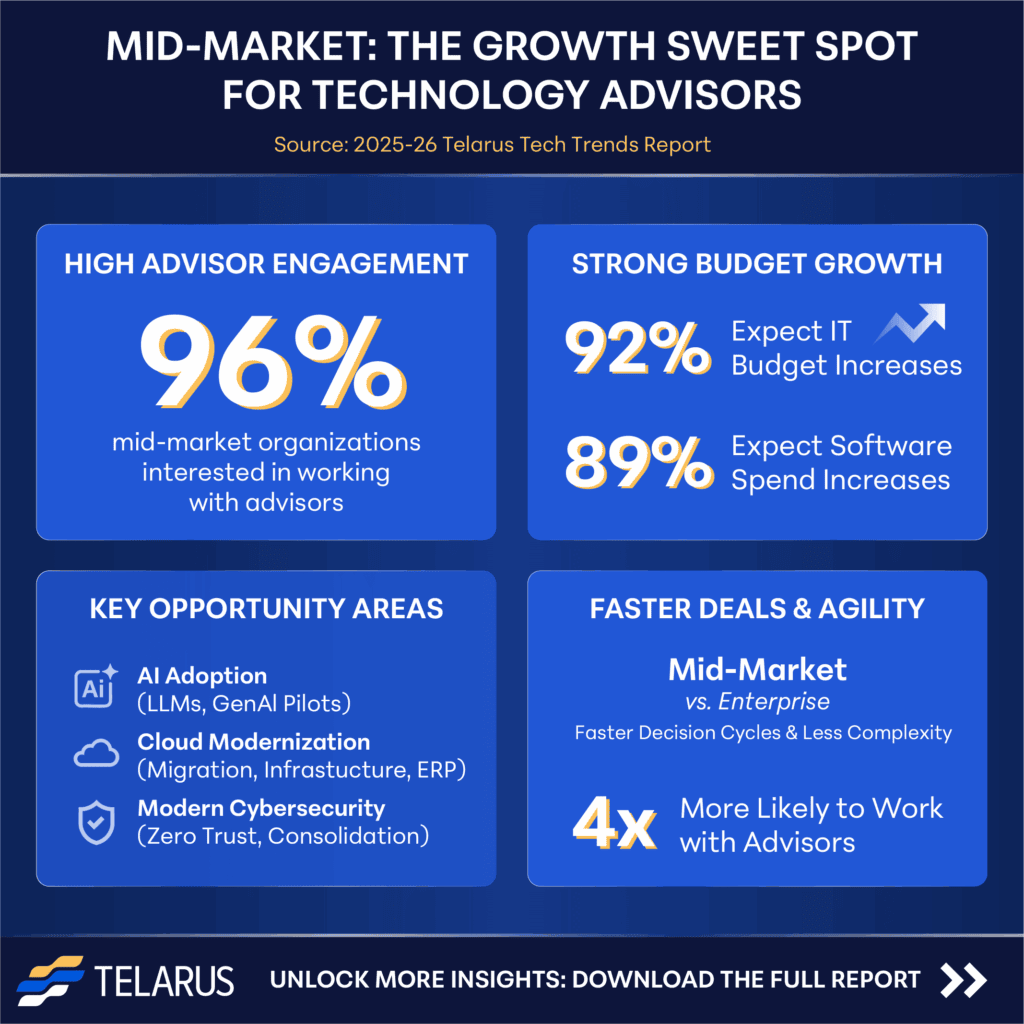
Technology advisors are far more likely to find quick wins in the mid-market. According to the 2025-26 Telarus Tech Trends Report, mid-market organizations now offer the greatest near-term growth opportunity.
This is largely because mid-market buyers are open to receiving guidance from technology advisors. In fact, 96% of mid-market respondents said that they are interested in working with advisors, compared to one-third of enterprise buyers. In addition, 75% of mid-market respondents said that at least 26% of their tech buying is done through advisors.
Telarus also found that mid-market companies are leading in technology spend, with 92% of mid-market buyers expecting IT budget increases compared to 45% of large enterprises. Meanwhile, 89% of mid-market buyers expect to increase software spend, compared to 57% of enterprise buyers.
“This signals a strong reliance on tools to fill capability gaps,and greater openness to outside advisory as a force multiplier,” the report explains. “Enterprise buyers, meanwhile, are scaling back on both fronts, reflecting a more cautious and cost-centered mindset.”
Top Mid-Market Opportunities for Technology Advisors
AI
Mid-market organizations are adopting AI and experimenting with it more freely, but often lack the resources and bandwidth to implement solutions independently. “They’re interested in LLMs, GenAI pilots, and better deployment practices, but face resource and risk constraints,” the report says.
Cloud Modernization
Mid-market buyers ranked cloud modernization as their second-highest external support need (63%), meaning advisors have a strong opportunity to guide migration and infrastructure upgrades. Key areas include ERP/suites, containerization, cloud-native, edge computing, and multicloud.
Modern Cybersecurity
IT buyers in mid-market companies are more likely to require external cybersecurity support than enterprise buyers—specifically around zero trust, consolidation, passwordless authentication, and integrated security.
How to Pursue Enterprise Opportunities
While the mid-market offers significant upside for technology advisors, the enterprise market is also rich with opportunity. Buying cycles may be longer and more challenging, yet a single enterprise deal can still be more profitable than several smaller mid-market deals.
Here are some challenges to expect when approaching enterprise buyers, and tips for overcoming them.
Managing Complex Buying Processes
Enterprise customers have more internal stakeholders and board members, which may complicate and delay buying decisions. Technology advisors should be prepared to spend more time on planning, documentation, and consultative selling when working with enterprise buyers.
Earning Trust
Large enterprise buyers also tend to be more selective about who they work with. According to Telarus’ research, 73% of enterprise buyers said that 25% or less of their buying is done through advisors. When large enterprise buyers seek new partners, they value depth of knowledge in specific technologies over general support.
Aligning with Enterprise Priorities
Enterprise buyers prioritize cost over innovation. In fact, large enterprises are 4x more likely to have investment decisions influenced by cost-cutting than mid-market companies. Technology advisors can use cost-cutting opportunities to fund innovation, which is seeing increased investment.
Tips for Approaching Mid-Market and Enterprise Buyers
With the right strategy and mindset, technology advisors can thrive in both the mid-market and enterprise arenas.
Telarus recommends advisors tailor their approach based on buyer mindset and segment, while keeping the following points in mind:
- Qualify early to identify each buyer’s priorities, and tailor your consulting path accordingly.
- Frame value strategically and share examples of how other clients have either reduced spend or achieved growth.
- Guide with outcomes, while emphasizing phased implementation and ROI-based planning.
Get Additional Insights to Guide Your Selling Conversations
This is a small snippet of what you’ll find in the 2025-26 Telarus Tech Trends report—a comprehensive, interactive resource offering the latest insights around buyer needs and opportunities in the channel.